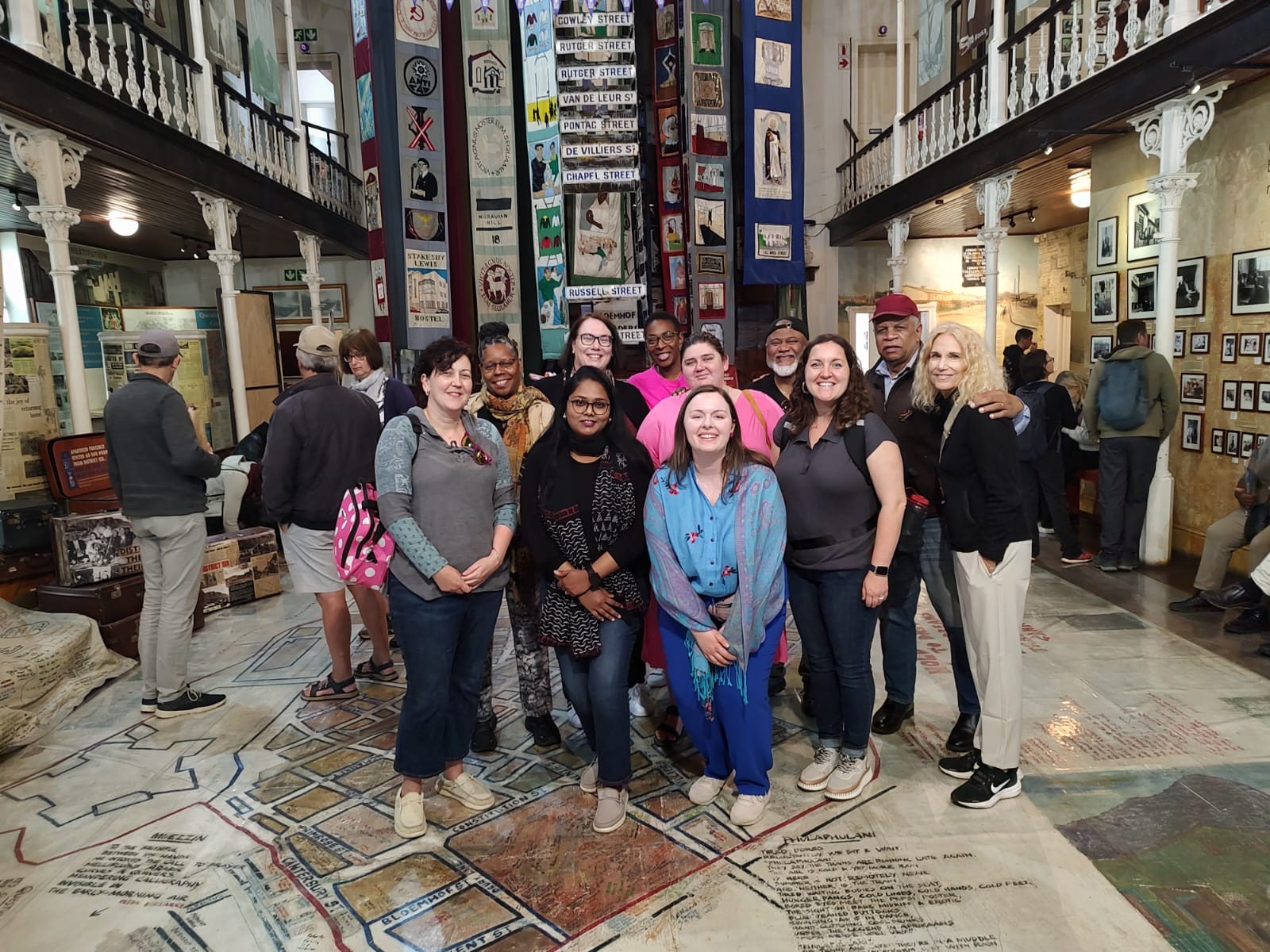
Photos and reflections from the second half of our trip:
Day 6
Day 7
The "welcome" sign at St. George's Cathedral in Cape Town.
Day 8
Photos and reflections from the second half of our trip:
Day 6
Day 7
The "welcome" sign at St. George's Cathedral in Cape Town.
Day 8
This post is about God's creation, specifically the land and the earth. The South Africa travel seminar has enabled me to see a whole different part of God's creation. I've found myself reflecting and making connections about God's creation.
"The earth is the Lord’s and everything in it, the world and its inhabitants too."
Psalm 24:1 from the Common English Bible
In April 2024, St. Andrew Presbyterian Church hosted Dr. Nancy Stockdale, Associate Professor at the University of North Texas, for a lecture about Palestinian culture and identity. I was lucky enough to attend the lecture in-person and learned about the history of Palestinian people and about Palestinians in our modern world. One of my main takeaways from the lecture was the importance of land. As people who have been displaced for generations, Palestinians have a strong connection with creation. Olive trees and other plants are vital to families' histories and livelihoods. For the last 7 months, an ecocide (click here to learn more about ecocide) has been enacted on Palestinian land. Olive trees and indigenous plants that have been in families for hundreds of years are now destroyed. The Palestinian people have been on my heart and mind this week especially because of the many ways that Palestinians and South Africans relate to each other. Before this week, I had not though of South Africa's apartheid and the genocide in Palestine as being such strong points of solidarity for the Palestinian and South African peoples. So as I reflect on the lecture from Dr. Stockdale, my time learning in South Africa, and the importance of land to Palestinian peoples, I see the direct connection to Psalm 24:1.
"The earth is the Lord's and everything in it, the world and its inhabitants, too."
The connection to Psalm 24:1 resurfaced for me when our travel seminar group visited the District 6 Museum last week. In my previous blog post, I wrote a bit about District 6, but this is just a reminder that District 6 is one of the hundreds of neighborhoods in South Africa where people were forcibly removed from their homes during apartheid. At the District 6 Museum, we had a guided tour led by a woman named Faranaaz whose family was forcibly removed from their home when she was a teenager. Faranaaz began the tour by telling us the history of South Africa's Western Cape/Cape Point (which is the southwestern-most point of Africa). The Khoi people are the indigenous people to South Africa. They lived between the mountains and the ocean. The Khoi people used waterfalls/water passages in the mountains for drinking, cooking, etc. When the first colonizers stopped at Cape Point as their "pit stop" on a long journey, the Khoi people shared their drinking water with them. The Khoi people lived off the land and they passed this tradition to their descendants. The people who lived in District 6 had a connection to the land from their Khoi ancestors. So when the residents of District 6 were forcibly removed from their homes to places behind the mountains and away from the water, they lost this connection to their ancestors. Faranaaz said her family always felt connected to the mountains and the ocean and then suddenly, they lost that direct connection.
"The earth is the Lord's and everything in it, the world and its inhabitants, too."
Earlier this week we had the privilege to watch a 45min documentary about housing inequalities in South Africa. We learned about a resident of Langa, which is the Black township we visited last week, who has an organization in his neighborhood. The organization is mainly an art gallery but it also has a community garden and a tree-planting ministry. The founder of the organization emphasized the importance for all people to live in places with green spaces and trees. Green space, trees, and gardens improve the quality of life for people physically, mentally, and emotionally. The poorest areas of Cape Town do not have trees or green spaces; I think this is the same for urban areas in the USA, too. There is a noticeable difference between the number of trees in wealthier areas of cities than in poorer areas of cities and often this difference falls along the lines of race.
"The earth is the Lord's and everything in it, the world and its inhabitants, too."
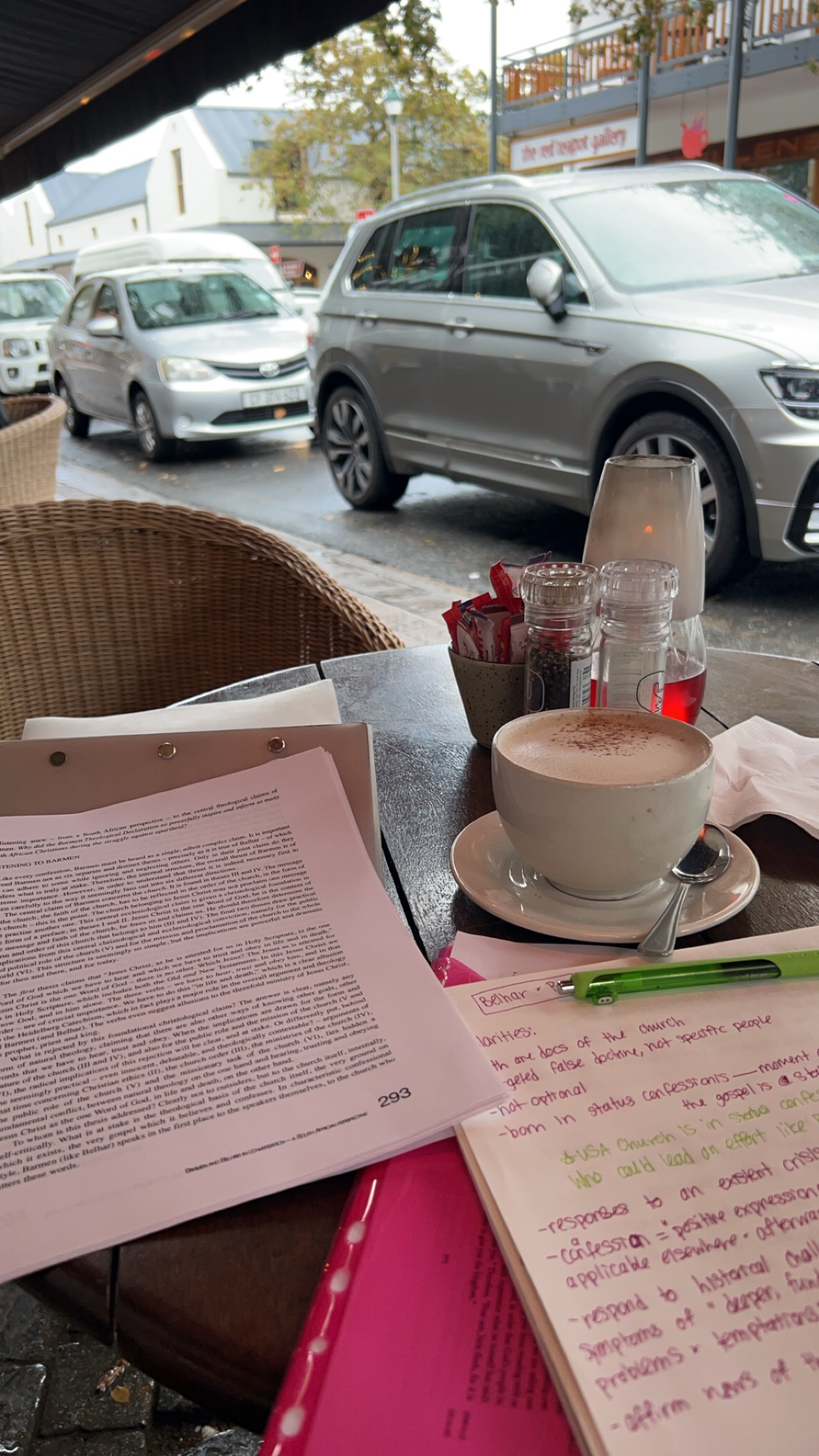
We're taking a class this week with students at the University of Stellenbosch and it's about contemporary confessions. We are learning about the Barmen Declaration, The Belhar Confession, The Accra Confession, and the Kairos Document. The Accra Confession of 2004 is focused on the tension between economy and ecology. It's based on the theological conviction that economic and ecological injustices require the Reformed family to respond as a matter of faith in the Gospel of Jesus Christ. Our professor, Dr. Mahokoto, emphasizes that climate change threatens the environment, disrupts communities, and destroys livelihoods. Thus, climate change impacts the economy and vice versa. Wendell Berry describes the connection between ecology and economy this way: "Whether we and our politicians know it or not, Nature is party to all our deals and decisions and she has more votes, a longer memory, and a sterner sense of justice than we do." As God's people who are part of God's creation, we are called and required to treat God's creation with justice and respect.
"The earth is the Lord's and everything in it, the world and its inhabitants, too."
The land of the Palestinian peoples is the Lord's. As Christians, we're called and required to treat the Palestinian people and their land justly and respectfully.
The land of the Khoi people and the land of the residents of District 6 is the Lord's. As Christians, we're called and required to treat the land of District 6, the land of the Khoi people, and the people of District 6 (and all areas of the world) justly and respectfully.
The land of Langa is the Lord's. As Christians, we're called and required to treat the land in Langa with justice and respect.
"The earth is the Lord's and everything in it, the world and its inhabitants, too."
Friends, I'm not exactly sure what my next steps are in relation to ecology, our earth, and our land. I don't have all the answers for what I can do next. But I plan to continue learning, praying, and finding ways to embody God's love and justice --- with people and with our whole earth. If there's one thing I've learned this week (beyond the original confession of the church, which is "Jesus is Lord"), it's that confessions serve not just as a a response to a particular crisis but as our beliefs that we are called and required to embody through our actions, not just our words.
With Love and Gratitude,
Caitlin
The Spring semester ended last week and I cannot believe how fast time flies. Since I last posted, I have preached my final sermon at Ginter Park Presbyterian Church (sermon linked here) and led a fellowship activity as part of my final project. I have also co-led a Chapel service at Union Presbyterian Seminary's Richmond campus. The service was called Sow & Serve and was hosted by the Richmond Student Government Association's Service Deacon (me!) and Reap & Sow Ministries, which is a student-led, student-fed, student-bred ministry on UPSem's Richmond campus. I serve as a the Worship Coordinator for Reap & Sow Ministries and hope to make this "worship-through-work" experience an annual service. For Sow & Serve, we brought in local organizations and ministries to share their work with our UPSem community. I prayed this prayer, which is written by John van de Laar on the Sacredise website, and it summed up our worship service perfectly:
God of Justice,
We may not be able to confront queens,
or challenge presidents;
We may not have the capacity to divert resources,
or uplift communities;
We may not have the voice to silence the noise of war,
or the words to negotiate peace between armies;
But, as we follow you, O Christ, our firm foundation, we are able to do something.
And so, we pray that you would inspire us
to commit to and act on
the small difference we can make:
May we bring peace
through small acts of blessing
and reconciliation;
May we bring wealth
through small contributions
and collaborations;
May we bring safety
through small acts of consideration
and acceptance;
May we bring wholeness
through small acts of care
and service.
And in the small ways, O God,
may our difference make a big contribution
to your saving work in our world.
Amen.
In honor of approaching Holy Week, a group of folks gathered to create crosses after worship last Sunday at my internship. One of the church’s members is a wood-worker so he and his wife made a bunch of wood crosses from scrap wood. They brought all sorts of art supplies for us to use to decorate the handmade crosses. We had a beautiful time of fellowship with each other. We flexed our creative muscles as we reflected on the cross, Christ's boundary-breaking ministry, and his brutal death that saved all of us from our sins. What a wonderful experience, especially because I had just preached a sermon on Philippians 2:1-11!
I find it hard to believe that February is already drawing to a close. It feels like I just wrote my January blog post yet as I reflect on the last month, a lot has happened! This post is more informational than engaging, but I want to share these updates with y'all.
- At the end of January, I took 2 of the PCUSA ordination exams (Worship & Sacraments and Bible Exegesis). I spent over 50 hours on the exams in a period of 6 days. Months of preparation for both of the exams helped me to pass both of them (and I passed the Bible Content Exam last August), which is something for which I am grateful and of which I am very proud.
- As part of my internship, I attend Care Team (we do not have Deacons and instead have Ruling Elders and the Care Team) meetings monthly and I engage in pastoral care. At the February Care Team meeting, I experienced the joy of crafting with the Care Team. We made Valentine gifts (a pearl and lace Valentine decoration) for members of the church who are homebound. I loved delivering the gifts to a few members of the church and seeing the delight in their eyes.
- At the beginning of February I taught Sunday School at Ginter Park Presbyterian Church. I led a discussion about Aging & Spirituality, which was informed by seminars that I have attended at Westminster Canterbury in Richmond, VA. On that same Sunday, I co-led worship with my supervisor, Pastor Carla, and the President of Union Presbyterian Seminary, Dr. Jacqueline Lapsley. What a privilege and joy it was to co-lead worship alongside these two women ministers (Dr. Jacq is the first female president of Union Presbyterian Seminary & Pastor Carla is the first female minister of Ginter Park Presbyterian Church!).
- My husband and I traveled to Maryland on a Saturday to visit family and attend the Iowa Women's Basketball game versus University of Maryland. We loved watching the famous Caitlin Clark play basketball and seeing all of the University of Iowa fans who traveled in from so many places. Among the immense knowledge I have gained at my internship, I have learned the challenge of working on Sundays. Of course I knew about this challenge since I am a preacher's kid. But it is different when you are the one who is waking up early Sunday morning for a full day of work! I am grateful to my husband who drove us home from MD at 11pm on that Saturday so that I could sleep and be prepared for church in the morning. We are continuously learning what this balance looks like.
- I applied for and was selected to be a part of a Public Theology travel seminar to South Africa in May 2024 with my seminary. We will focus on public theology in South Africa, particularly as it relates to the work of justice and reconciliation in the aftermath of apartheid. The travel seminar will take place in collaboration with the School of Theology at the University of Stellenbosch, which houses the Beyers Naudé Center for Public Theology. We will visit sites of significance in the South African church struggle and participate in a class at the University of Stellenbosch on contemporary confessions, including the South African Kairos Document and the Belhar Confession. I am incredibly excited for this opportunity!
- Lent began at my internship with an Ash Wednesday Supper Church service. We fellowshipped over soup and bread, invited each other into a practice of Lenten discipleship, chatted with folks at our dinner tables about our spiritual practices, and then we received ashes (and I had the opportunity to impose ashes, which was a very powerful experience). As I reflected on the conversations with folks during Ash Wednesday Supper Church, I decided to add a spiritual practice to my life during this season of Lent. So far, my daily spiritual practice addition is either 5-10 minutes of centering prayer or doing "homework for life," which I learned about in my Introduction to Preaching class when we watched this TEDx video from Matthew Dicks.
I am grateful for the love, support, and prayers from my family, friends and church communities. May you feel God's constant love and boundless grace around you each day.
Peace and blessings,
Caitlin
For the last 6 months I have struggled with chronic hoarseness. As a parish intern who co-leads worship weekly and engages in many pastoral care visits, this has been difficult. Additionally, not being able to speak much in classes and not talking on the phone with family and friends has been an adjustment. In November, I was diagnosed with nodules on my vocal cords and muscle strain as a result of the nodules. I have been in speech therapy for the last six weeks. My biggest takeaway from speech therapy is the reminder to breathe --- and not just to breathe but to breathe properly; slowly, deeply, from the diaphragm, and often.
The deep breathing, which I now try to practice each time I speak, forces me to slow down and to speak intentionally. The practice of deep breathing enables me to pay close attention when I read scripture, to emphasize pauses between sentences while I preach, and to honor silence that comes between sentences, words, and deep breaths. My breath is a sign of my being alive and it is what helps my voice be unique and clear. The breath work that I am engaged in reminds me of the Hebrew word ruach, which means "breath" or "wind" or "spirit." When I breathe deeply, I invite myself to feel God's Spirit to move through and around me. Ruach dances, stretches, and blows in and around each of us. Sometimes, God's Spirit even stirs us in ways we never imagined. I am grateful for the gift of breath and for God's boundless Spirit who works in and among us. May we each find time to breathe deeply, to create space for God's spirit, and to be aware of how the Spirit might be guiding us.
Below is a copy of a breathing exercise that folks of Ginter Park Presbyterian Church (GPPC) engaged in when I preached and led worship on January 7th:
Breathe in the gifts of the Holy Spirit.
Let Her stir within you.
And breathe out the light that your gifts bring to illuminate our world.
What a last 10 days we've had in Richmond! I graduated from seminary, family came into town, we celebrated for multiple days, we finaliz...